By V. Rajesh Mohan Rao
A Broadcasting Legacy That Shaped Generations
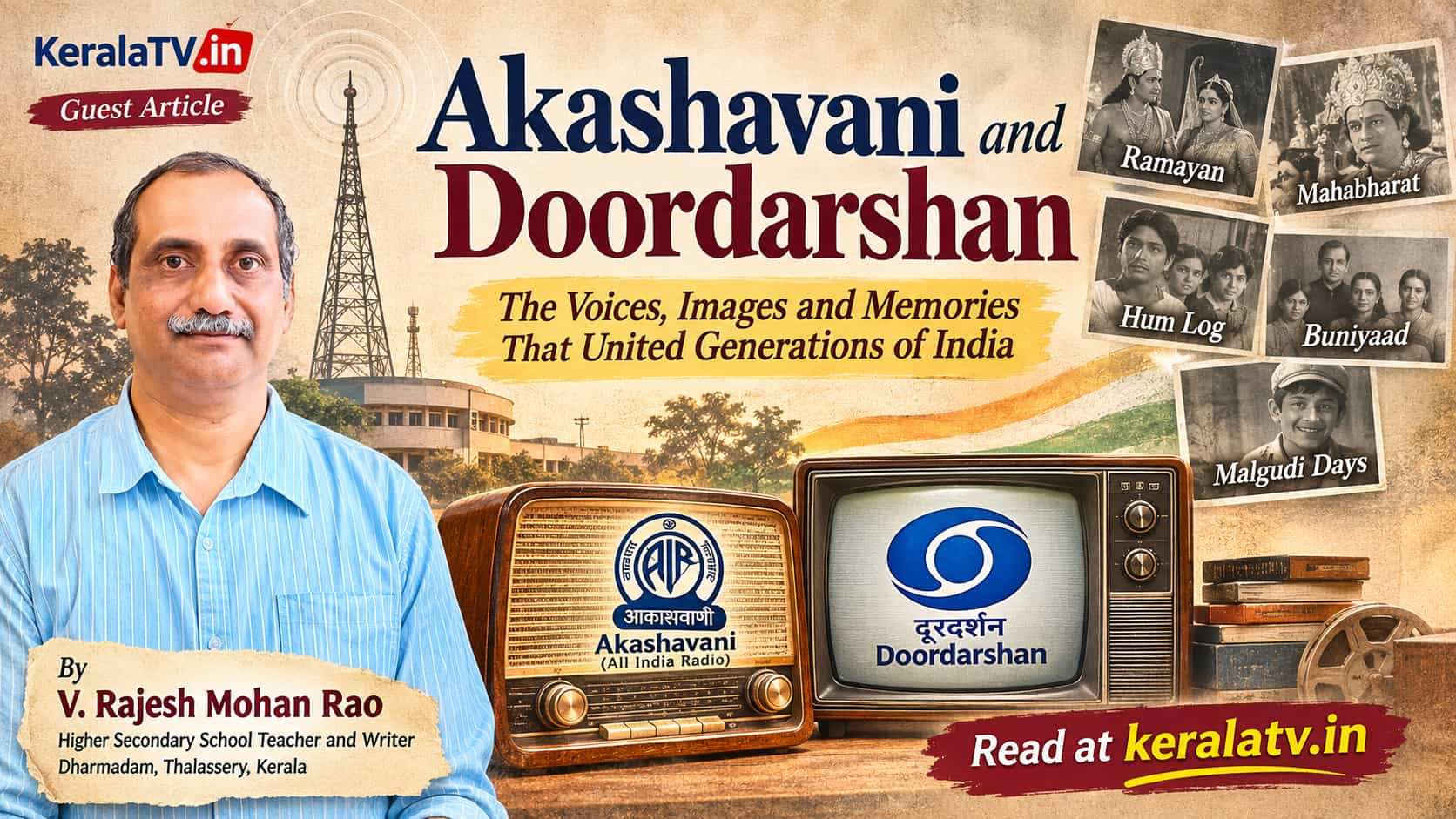
Every generation carries its own memories. For millions of Indians who grew up before the digital revolution, Akashvani (All India Radio) and Doordarshan hold a special place in their hearts.
One generation grew up listening to the radio, while another discovered the world through television. Today’s generation has smartphones, the internet and almost unlimited access to information and entertainment. Yet Akashvani and Doordarshan offered something beyond these conveniences.

They introduced us to India’s languages, traditions, history, culture, cinema, sports and everyday life. More importantly, they helped people understand the diversity of our country.
Even today, when older people recall their favourite programmes, familiar voices or memorable broadcasts, their faces often reflect genuine happiness. These memories are not merely about two broadcasting organisations. They represent an important part of their lives.
Akashvani: The Familiar Voice in Indian Homes
For decades, Akashvani was a trusted companion in countless Indian households.
Morning news bulletins, music, discussions, agricultural programmes, cultural broadcasts and national events connected ordinary families with the wider world.
I have often noticed elderly people, particularly those above seventy, listening to Akashvani from early morning, sometimes around six o’clock, and tuning in at different times throughout the day until bedtime.
It makes me happy to see that radio continues to hold such an important place in their daily lives.
The familiar voices of announcers, signature tunes, old film songs and special programmes bring back memories that modern technology cannot easily replace.
Vividh Bharati, which began in 1957, became particularly popular for its film songs and entertainment programmes.
Akashvani also provided a platform for classical music, folk traditions, literature, radio plays, interviews and meaningful discussions.
At a time when travel and access to information were limited, radio connected listeners with people, places and cultural traditions beyond their immediate surroundings.
Doordarshan: When Television Brought Families Together
Doordarshan introduced a different kind of experience into Indian homes.
Its experimental television service began in Delhi on September 15, 1959, while regular daily transmissions started in 1965.
Television was initially a luxury that only a limited number of households could access. As Doordarshan expanded its reach, it gradually became an important part of family life.
I still remember the excitement of waiting for our favourite television programmes.
Hindi serials, children’s shows, news bulletins, film songs, advertisements and special broadcasts had their own unique attraction.
Programmes such as Hum Log, Buniyaad, Malgudi Days, Ramayan and Mahabharat became part of India’s collective television memories.
Watching Hindi-language serials also helped many viewers become more familiar with the language.
The advertisements of that period, with their memorable music and simple presentation, remain equally unforgettable.
Television viewing was often a family occasion. Parents, children, relatives and sometimes neighbours gathered around a single television set to enjoy programmes together.
That shared experience created memories extending far beyond the programmes themselves.
Education, Agriculture and Discovering India Through Television
One of Doordarshan’s greatest contributions was its ability to educate while entertaining.
Krishi Darshan, launched in 1967, demonstrated how television could support farmers and rural communities.
Agricultural information, improved farming practices and rural development programmes helped viewers understand subjects directly connected to their livelihoods.
Doordarshan also introduced audiences to educational, spiritual, cultural and adventure-related programmes.
Broadcasts exploring books, literature, history, geography, monuments, tourism and places of interest encouraged viewers to learn about the country.
We could discover landscapes, historical locations and traditions that we might never have had an opportunity to experience personally.
These programmes created curiosity and encouraged learning.
Television was not simply a source of entertainment. It became a window through which ordinary people could explore India and the wider world.
How Indian Cinema Helped Us Understand Different Cultures
Cinema played an equally important role in shaping my understanding of India.
Through films, film songs, interviews and cinema-related programmes, Akashvani and Doordarshan introduced audiences to the artistic traditions of different regions.
Watching Malayalam, Tamil, Telugu, Kannada, Bengali, Hindi and other Indian-language films helped me understand the social life, customs, emotions and cultural backgrounds of people beyond my own region.
Even when we could not understand every word of a film’s dialogue, its performances, music and visual storytelling communicated something meaningful.
These experiences gradually strengthened my interest in cinema and encouraged me to appreciate films from different perspectives.
I believe my exposure to cinema in various Indian languages contributed significantly to my development as a film reviewer and critic.
For me, cinema became a window into India’s remarkable cultural diversity.
Akashvani complemented this experience through film songs, recorded music, interviews and programmes dedicated to cinema.
Cricket Memories: Doordarshan Telecasts and Akashvani Commentary
Sports, particularly cricket, created some of the most unforgettable memories associated with public broadcasting.
Many Indians still remember spending hours in front of a television watching important cricket matches on Doordarshan.
For countless families, a live cricket telecast was a special occasion.
Friends and neighbours gathered together, following every ball with excitement. A boundary, a wicket or a close finish could create celebrations and conversations that continued long after the match.
Doordarshan helped bring televised cricket to a much wider audience.
Akashvani made an equally remarkable contribution through radio cricket commentary.
The commentator’s voice, the description of each delivery, the excitement surrounding a boundary and the tension of a close contest created vivid images in the listener’s imagination.
Even today, I feel a special longing to hear that style of cricket commentary.
It possessed a beauty of its own.
Before television became widely accessible, radio commentary enabled people across the country to follow matches and experience the excitement of cricket.
Together, Akashvani and Doordarshan helped transform the sport into a shared experience for millions of Indians.
Bringing India’s Languages and Cultures Together
India is home to many languages, religions, traditions and cultural identities.
Akashvani and Doordarshan played an important role in helping people understand and appreciate this diversity.
Through national programmes, regional-language broadcasts, music, drama, news, sports and cultural presentations, these institutions introduced audiences to communities beyond their own.
A listener in Kerala could become familiar with the music and traditions of another state. A television viewer in one region could discover the festivals, customs and everyday life of people living elsewhere in India.
Such experiences encouraged cultural understanding and helped strengthen the feeling of belonging to a larger nation.
The older generation may not have enjoyed the technological advantages available today, but it possessed valuable knowledge, patience and life experience.
We should never underestimate those who developed their understanding of the world through radio, newspapers, books and the television programmes available during their time.
Their experiences and wisdom continue to guide younger generations.
The Importance of Public Broadcasting in the Digital Age
The arrival of private television channels, cable networks, the internet and digital streaming platforms transformed India’s broadcasting landscape.
Doordarshan no longer occupies the same position it once held in the daily entertainment habits of many households.
Akashvani, meanwhile, continues to reach listeners through traditional radio and digital platforms.
However, the importance of public-service broadcasting has not disappeared.
Commercial entertainment cannot completely replace programmes that educate, inform, preserve cultural traditions and serve communities.
There remains a need for reliable news, agricultural guidance, educational content, children’s programmes, regional-language broadcasting, literature, music and meaningful discussions.
Public broadcasters must continue adapting to changing technologies while preserving the values that made them important to generations of Indians.
Preserving the Memories and Legacy of Akashvani and Doordarshan
I feel proud when I think about the contribution of Akashvani and Doordarshan to India’s cultural and social life.
When older people recall their favourite radio programmes, television serials, advertisements, familiar songs or cricket commentary, their expressions often reveal genuine happiness.
That happiness tells us how deeply these institutions touched people’s lives.
The voices that once came through radio sets and the images that appeared on old television screens may belong to another era, but their influence remains.
We should preserve this valuable legacy and ensure that future generations continue to have access to programmes that enrich knowledge, language, culture and human understanding.
Technology will continue to change, but the need for meaningful communication and shared experiences will remain.
Akashvani and Doordarshan deserve our appreciation not only for what they broadcast, but also for the memories, knowledge and sense of togetherness they gave to generations of Indians.
About the Author
V. Rajesh Mohan Rao is a Higher Secondary School Teacher and writer based in Dharmadam, Thalassery, Kerala.
This article reflects the author’s personal memories, observations and appreciation of the contribution of Akashvani and Doordarshan to Indian society.